


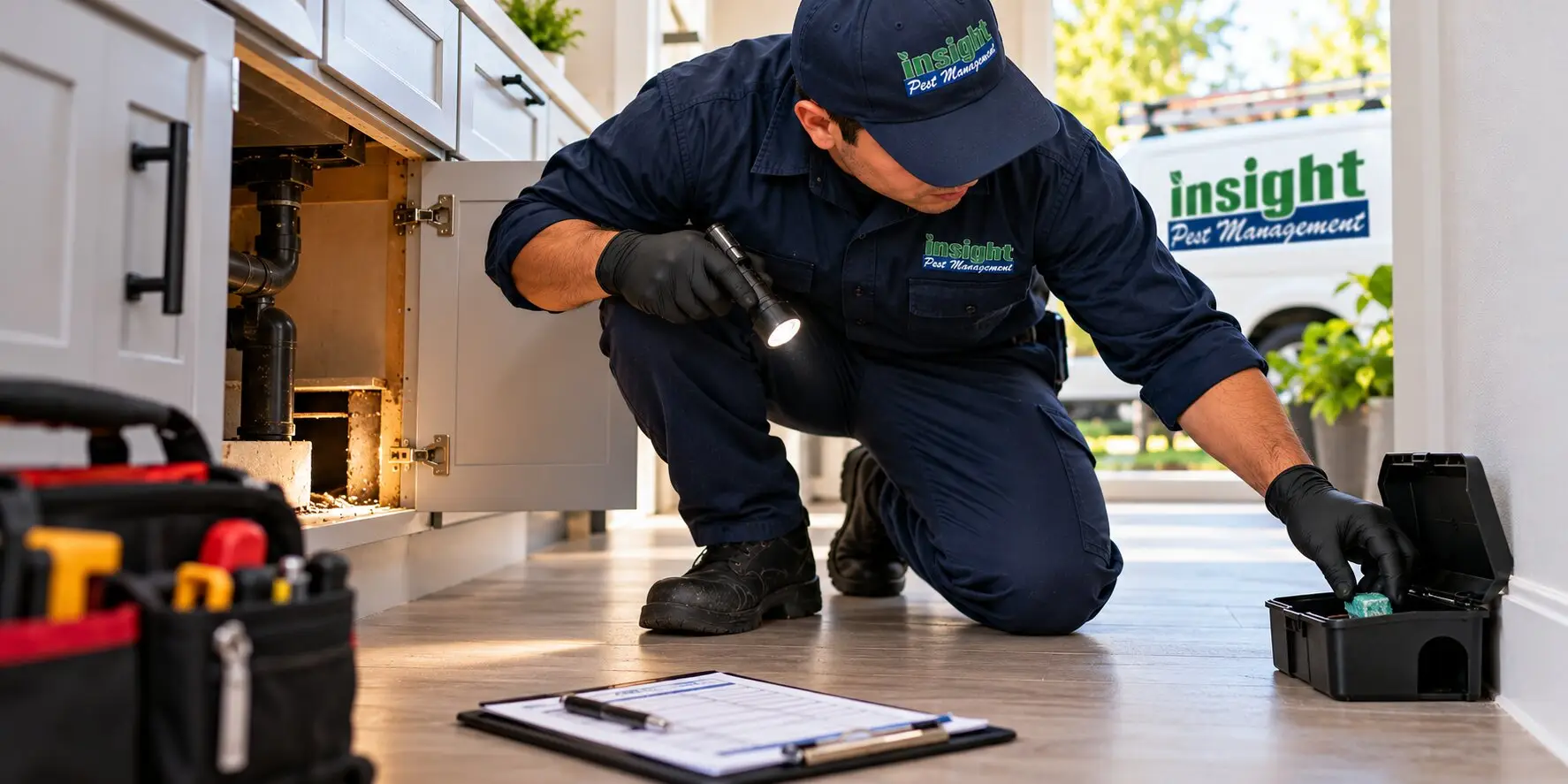

Finding rats in or around your home can be stressful, but professional rat control involves much more than placing a few traps and hoping the problem disappears.
A complete rat extermination service should identify where the rodents are active, determine how they are entering the property, reduce the current population, address structural vulnerabilities, and help prevent future infestations.
Insight Pest Management provides science-based rodent control throughout Ventura County and surrounding Southern California communities. Led by Associate Certified Entomologist Israel Alvarez, Insight Pest Management takes a detailed, prevention-focused approach to rat problems rather than treating only the symptoms homeowners can see.
While every property is different, professional rat extermination commonly includes inspection, trapping or removal, entry-point identification, exclusion recommendations, sanitation guidance, and follow-up monitoring.
Here is what homeowners can generally expect from a professional service.
What Happens During the Initial Rat Inspection?
The first step is usually a detailed inspection of the property.
The technician will look for evidence of rat activity and try to determine where rodents are living, traveling, and entering the structure.
Possible signs include:
- Droppings
- Gnaw marks
- Grease or rub marks
- Tracks
- Nesting material
- Damaged insulation
- Chewed food packaging
- Scratching sounds
- Urine staining
- Disturbed storage areas
The inspection may include both the interior and exterior of the property.
That matters because removing rats from the attic or garage is only part of the problem if the entry point remains open.
Which Areas of the Home Are Usually Inspected?
Professional rat inspections commonly focus on areas where rodents are most likely to find shelter or access.
These may include:
- Attics
- Garages
- Crawl spaces
- Kitchens
- Storage rooms
- Utility areas
- Rooflines
- Eaves
- Vents
- Garage doors
- Exterior walls
- Utility penetrations
- Landscaping near the structure
The technician may also ask where you have heard scratching or found droppings.
Those details can help narrow down likely travel routes.
Why Is Rat Species and Behavior Important?
Understanding rodent behavior can influence where a professional looks for activity.
Some rats are excellent climbers and may enter through rooflines, attic vents, or upper structural gaps. Others may take advantage of lower openings around garages, foundations, crawl spaces, or utility lines.
Professional pest control considers how rats move through the environment.
That is one reason Insight Pest Management emphasizes science-based inspection.
Owner Israel Alvarez brings nearly 20 years of professional pest management experience to the company, and his background as an Associate Certified Entomologist helps guide treatment decisions around pest behavior and habitat.
Does Professional Rat Service Include Trapping?
Trapping is commonly used as part of professional rat control.
The type, number, and placement of traps depend on where activity has been identified.
Professionals may place traps:
- Along established runways
- Near nesting areas
- In attics
- Near wall edges
- In garages
- Around areas where droppings are concentrated
Rat traps are most effective when they are positioned based on rodent movement rather than placed randomly.
A technician may adjust trap locations over time based on activity.
Why Does Trap Placement Matter?
Rats often follow consistent routes.
They may travel along walls, beams, roof edges, or other structural features.
A trap placed in the middle of an open space may be ignored, while one placed directly along an established runway may be more effective.
Professionals look for clues such as:
- Dropping patterns
- Grease marks
- Tracks
- Gnaw damage
- Disturbed insulation
- Repeated movement areas
These signs help determine where traps are likely to intercept rodents.
Does Rat Extermination Include Poison Bait?
Treatment methods vary depending on the property and infestation.
Rodenticides may be used in some professional rodent management programs, but they are only one possible tool.
A professional should consider factors such as:
- Where the rats are living
- Whether pets or children are present
- Property layout
- The severity of the infestation
- Risks associated with inaccessible carcasses
- Local conditions
- Whether exterior rodent pressure is contributing
Rat control should never be reduced to simply placing poison without addressing entry points.
Even if the current rodents are removed, new rats may enter if structural openings remain.
What Is Rodent Exclusion?
Rodent exclusion is the process of identifying and correcting openings that allow rats into a structure.
This is one of the most important parts of long-term rat control.
Potential entry points may include:
- Damaged vents
- Roof gaps
- Eaves
- Fascia openings
- Utility penetrations
- Gaps around plumbing
- Garage door openings
- Crawl space access points
- Damaged exterior materials
A professional may recommend sealing or repairing these areas once the active infestation has been appropriately addressed.
The goal is to make it much harder for new rodents to gain access.
Does the Exterminator Seal Every Hole Immediately?
Not necessarily.
Timing matters.
If rats are still inside the structure, sealing every suspected entry point too early may trap rodents indoors.
A professional rodent control plan should coordinate removal and exclusion.
The technician may first determine:
- Which openings are actively being used
- Whether rodents remain inside
- Where traps should be placed
- When exclusion work should begin
- Whether certain openings require one-way strategies or other methods
This planned sequence is one of the advantages of professional service.
Does Rat Extermination Include Attic Inspection?
Yes, if there are signs of attic activity.
Attics are common locations for rats because they offer shelter, warmth, nesting material, and protection from people.
A technician may look for:
- Droppings
- Nesting material
- Damaged insulation
- Gnaw marks
- Travel paths
- Entry points near rooflines
- Contaminated areas
The inspection may also help connect interior evidence with exterior access points.
For example, disturbed insulation near one side of the attic may lead the technician to inspect the nearby eaves or roof vents more closely.
Does Professional Service Include Cleanup?
Basic rat control does not always include full cleanup or attic restoration.
These may be separate services depending on the company and extent of contamination.
However, a technician may identify areas where droppings, nesting material, or contaminated insulation are present and explain whether additional cleanup may be appropriate.
Homeowners should avoid casually sweeping or vacuuming large accumulations of rodent droppings without understanding proper cleanup precautions.
The specific cleanup approach depends on the level and location of contamination.
Will the Technician Look for Food Sources?
Yes.
Food availability can make a property more attractive to rats.
Professionals may inspect for conditions such as:
- Pet food stored in garages
- Bird seed
- Open trash
- Fallen fruit
- Stored food
- Outdoor feeding areas
- Improperly sealed containers
A technician may recommend changing how these items are stored or managed.
Reducing food access helps make the property less supportive of rodent activity.
Does Water Matter for Rat Infestations?
Yes.
Rats also need access to water.
Potential sources may include:
- Leaking faucets
- Pet water bowls
- Irrigation
- Standing water
- Plumbing leaks
- Outdoor containers
Correcting unnecessary water sources can help make the environment less attractive.
Professional rodent management considers food, water, shelter, and access together rather than focusing only on the animals themselves.
Will the Exterminator Inspect Landscaping?
Often, yes.
Exterior conditions can make it easier for rats to reach a home.
Technicians may look at:
- Tree branches touching the roof
- Dense shrubs against the structure
- Vines
- Fences
- Trellises
- Stacked materials
- Clutter near exterior walls
A branch reaching the roof can give climbing rats easier access to vents, eaves, and roof gaps.
The professional may recommend trimming or modifying certain landscaping when it creates a clear rodent pathway.
Does Rat Control Include Monitoring?
Monitoring is an important part of many professional rodent programs.
After traps or other control measures are placed, the technician may return to check activity.
Follow-up can help determine:
- Whether rats are still present
- Which areas remain active
- Whether trap placement should change
- Whether exclusion work is holding
- Whether new entry points are being used
Monitoring is especially valuable because homeowners may stop hearing noises before the infestation has been completely resolved.
Why Are Follow-Up Visits Important?
Rat infestations do not always disappear after one visit.
Follow-up allows the pest professional to adapt the strategy based on actual results.
During later visits, the technician may:
- Check traps
- Remove captured rodents
- Reset or relocate traps
- Inspect for fresh droppings
- Recheck suspected entry points
- Evaluate exclusion repairs
- Look for new activity
The goal is to confirm that rodent activity has stopped rather than assuming the problem is gone.
How Long Does Professional Rat Extermination Take?
There is no single timeline.
The length of treatment depends on factors such as:
- Number of rats
- Location of the infestation
- Building size
- Number of entry points
- Accessibility
- Available food and water
- Exterior rodent pressure
- Effectiveness of exclusion work
A small problem discovered early may be resolved more quickly than an infestation that has been established in an attic or wall system for months.
Professional service should focus on confirmed reduction and elimination of activity rather than promising the same timetable for every home.
What Should Homeowners Do During the Treatment Process?
Homeowner cooperation can make rodent control more effective.
You may be asked to:
- Store food in sealed containers
- Remove pet food at night
- Secure garbage
- Reduce garage clutter
- Trim vegetation
- Repair leaks
- Avoid disturbing traps
- Report new sounds or droppings
- Keep certain areas accessible
If you notice new activity, tell the technician where and when it occurred.
Details can help refine the treatment strategy.
What Should You Avoid Doing?
Avoid making major changes that could interfere with professional treatment without discussing them first.
For example, homeowners sometimes seal every visible hole immediately after discovering rats.
That can create problems if animals are still inside.
You should also avoid moving professional traps unless instructed.
If you have questions about a suspected opening or treatment area, contact the pest control provider before changing the setup.
Can Rats Return After Professional Treatment?
Yes, especially if new openings develop or exterior rodent pressure remains high.
Rodent control is not a permanent guarantee that another rat will never approach the property.
That is why prevention matters.
Helpful steps include:
- Maintaining exclusion repairs
- Checking garage door seals
- Monitoring vents
- Trimming vegetation away from rooflines
- Storing food securely
- Managing garbage
- Reducing clutter
- Watching for new droppings or gnawing
Early detection can prevent a minor issue from becoming a larger infestation.
What Makes Rat Control Different From Simply Catching Rats?
Catching rats addresses the current animals.
Professional rodent management aims to address the entire situation.
That can include:
- Identifying active rodents
- Finding nests
- Removing or trapping rats
- Locating entry points
- Correcting structural vulnerabilities
- Reducing food and water sources
- Monitoring for continued activity
- Preventing future access
The entry-point piece is especially important.
If a rat can still get into the attic tomorrow, removing today’s rat may provide only temporary relief.
Why Does Professional Expertise Matter?
Rats are adaptable animals.
They can climb, gnaw, squeeze through small openings, and learn to avoid unfamiliar objects.
Successful control often requires understanding those behaviors.
Insight Pest Management is founded and operated by Israel Alvarez, an Associate Certified Entomologist with nearly two decades of professional pest management experience.
Israel has held his Associate Certified Entomologist credential since 2013 and a California Pest Control Operators License since 2014. He also serves as Vice Chair of the Pest Control Operators of California–Ventura District.
That combination of practical field experience and science-based knowledge helps the Insight team approach rodent problems systematically.
The goal is not just to place traps.
It is to understand why the rats are there and how to prevent the same problem from repeating.
What Should a Complete Professional Rat Extermination Service Include?
While every treatment plan is different, a comprehensive professional service may include:
- Detailed interior inspection
- Exterior inspection
- Identification of rat activity
- Entry-point evaluation
- Trap placement
- Rodent removal
- Exclusion recommendations
- Food-source evaluation
- Water-source evaluation
- Landscaping recommendations
- Follow-up monitoring
- Adjustments based on continued activity
The exact combination depends on what the property inspection reveals.
A professional should explain both the immediate control strategy and the longer-term prevention plan.
Why Is Rat Control Important for Ventura County Homes?
Homes throughout Newbury Park, Thousand Oaks, Camarillo, Simi Valley, Moorpark, Oxnard, and surrounding Ventura County communities can experience rodent pressure throughout the year.
Southern California’s climate, mature landscaping, outdoor food sources, garages, attics, and varied home construction can all create opportunities for rodents.
Rats may move from outdoor environments into structures when they find a reliable opening and suitable shelter.
Local knowledge matters because technicians familiar with regional homes and pest patterns may recognize common access routes and environmental conditions more quickly.
Schedule Professional Rat Control With Insight Pest Management
A complete rat extermination service should do more than remove the rodents you can hear or see.
It should identify where rats are active, determine how they are getting inside, address the current infestation, and help reduce the risk of future entry.
Insight Pest Management provides science-based rodent control and exclusion guidance throughout Ventura County and nearby Southern California communities.
Led by Associate Certified Entomologist Israel Alvarez, the Insight team combines detailed inspections, targeted removal, monitoring, and prevention-focused recommendations.
If you’re hearing scratching in the attic, finding droppings, or seeing signs of rodents around your home, schedule an inspection with Insight Pest Management today. A professional evaluation can help identify the source of the problem and build a more complete solution.
