

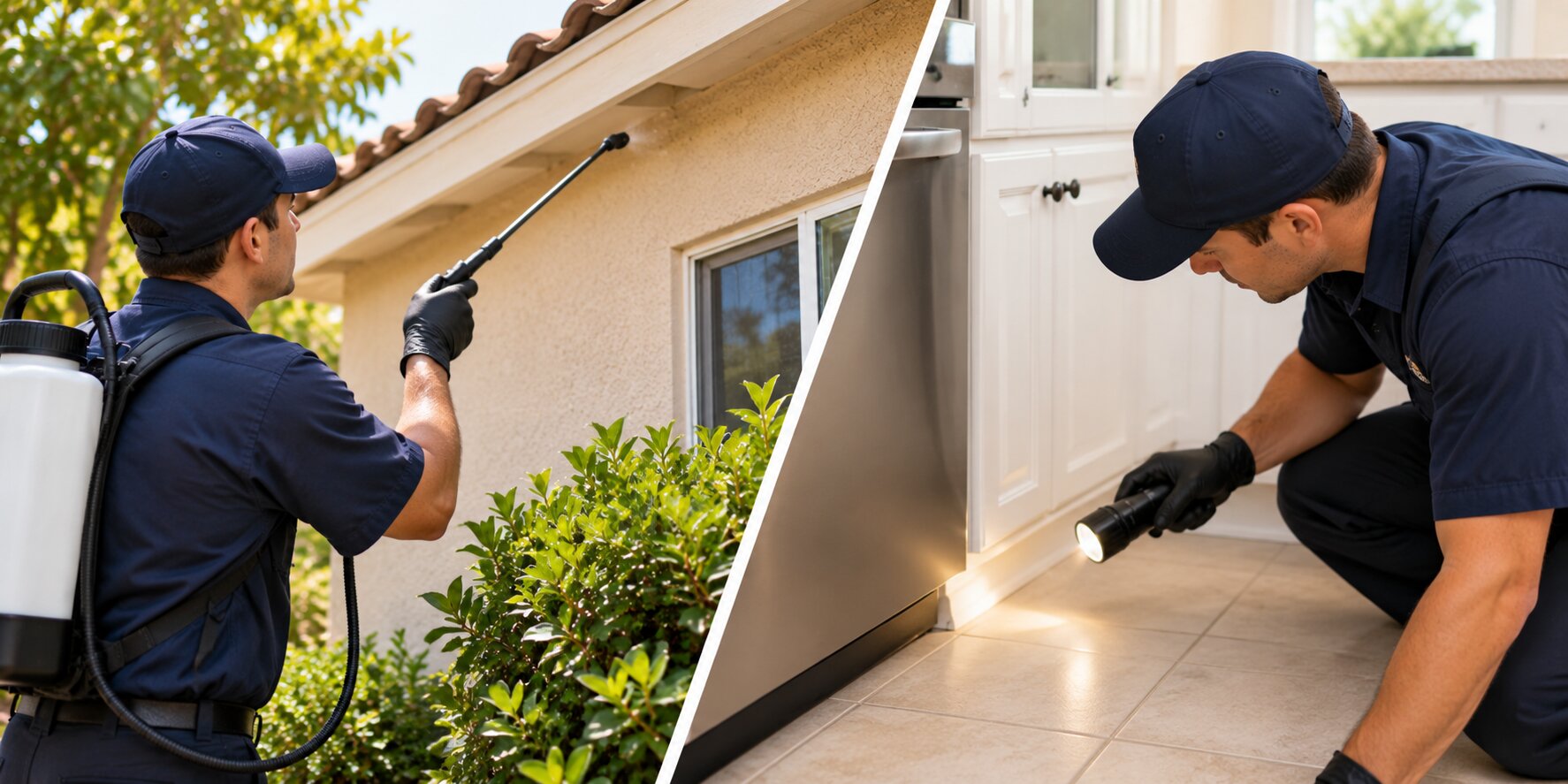

When homeowners think about pest control, they often picture someone spraying along baseboards inside the house. But for many pest problems, the most important treatment area may actually be outside.
Insight Pest Management helps homeowners throughout Ventura County determine where treatment should focus based on the pest, the property, and the conditions supporting the infestation. Led by Associate Certified Entomologist Israel Alvarez, Insight Pest Management uses a science-based approach that looks at how pests enter, where they live, and what attracts them to a home.
Some infestations require targeted interior treatment. Others are best managed primarily from the exterior. In many cases, the most effective approach combines both.
The right answer depends on what pest is present and what an inspection reveals.
What Is the Difference Between Interior and Exterior Pest Control?
Interior pest control focuses on pest activity inside the home.
Treatment may target areas such as:
- Kitchens
- Bathrooms
- Garages
- Utility rooms
- Baseboards
- Cabinets
- Cracks and crevices
- Plumbing areas
- Storage spaces
Exterior pest control focuses on the areas surrounding the structure where pests may live, travel, or enter.
Common treatment areas may include:
- Foundation edges
- Doors
- Windows
- Eaves
- Exterior cracks
- Garages
- Patios
- Landscaping near the structure
- Utility penetrations
The goal is not simply to choose one or the other.
Professional pest management focuses treatment where it is most likely to affect the actual pest problem.
Why Is Exterior Pest Control So Important?
Many household pests begin outside.
Ants, spiders, cockroaches, rodents, and other pests may approach the home from surrounding landscaping, soil, fences, neighboring areas, or outdoor shelter.
If they can find food, water, and an opening into the structure, they may move inside.
Exterior pest control can help reduce this pressure before pests become established indoors.
Professionals may focus on:
- Entry points
- Harborage areas
- Exterior pest populations
- Moisture conditions
- Landscaping
- Structural gaps
This prevention-first approach can reduce the need for unnecessary indoor applications.
When Is Interior Pest Control Necessary?
Interior treatment may be appropriate when pests have already become established inside the home.
Examples may include:
- German cockroaches in kitchens
- Ant activity around cabinets
- Mice in garages or walls
- Spiders in storage areas
- Bed bugs in sleeping areas
- Fleas indoors
- Other pests living within the structure
The treatment should still be targeted.
Professional pest control does not necessarily mean spraying every room.
Instead, a technician may focus on cracks, crevices, harborages, travel routes, or specific areas where activity has been confirmed.
Why Should Treatment Be Based on an Inspection?
Pest activity can look similar on the surface while having very different causes.
A homeowner may see ants in the kitchen, for example, but the colony could be outdoors.
Treating only the visible ants inside may reduce activity temporarily without addressing the source.
Likewise, spraying the exterior may not be enough if cockroaches have already established a breeding population behind kitchen appliances.
A professional inspection helps answer questions such as:
- What pest is present?
- Where is it living?
- How is it getting inside?
- What resources are supporting it?
- Does treatment need to focus indoors, outdoors, or both?
These answers help avoid unnecessary applications.
Which Pests Are Often Managed Primarily From the Exterior?
Many common household pests spend at least part of their life outdoors.
Exterior-focused management may be especially important for:
The technician may work to reduce pest activity before it reaches interior living spaces.
That can involve treatment, exclusion, web removal, landscaping recommendations, or moisture correction.
Which Pests Usually Require More Interior Attention?
Some pests become established indoors and require direct treatment inside the structure.
German cockroaches are a good example.
They may live and reproduce around:
- Appliances
- Cabinets
- Sinks
- Plumbing
- Food storage
Treating only the exterior would not adequately address a population already breeding indoors.
Bed bugs are another example because the infestation is directly associated with indoor sleeping and resting areas.
Professional treatment should follow the biology and behavior of the pest.
Does Interior Pest Control Mean Spraying Baseboards Everywhere?
Not necessarily.
Older pest control approaches often involved broad interior applications.
Modern professional pest management can be much more targeted.
Depending on the infestation, a technician may use:
- Baits
- Crack-and-crevice treatments
- Monitoring devices
- Targeted dust applications
- Traps
- Growth regulators
- Limited liquid treatments
The goal is to place treatment where pests are actually active.
This can reduce unnecessary pesticide use while improving the precision of the service.
How Does Integrated Pest Management Affect Treatment?
Integrated Pest Management, often called IPM, is a broader approach to pest control.
Rather than relying only on pesticide applications, IPM considers multiple ways to reduce pest activity.
That can include:
- Inspection
- Pest identification
- Monitoring
- Sanitation
- Exclusion
- Moisture correction
- Habitat reduction
- Targeted treatment
Insight Pest Management’s science-based approach reflects this kind of thinking.
Treatment is one tool.
Understanding why pests are present is just as important.
How Do Entry Points Influence the Treatment Plan?
If pests are entering through structural gaps, exterior inspection and exclusion can be critical.
Possible entry areas include:
- Gaps beneath doors
- Damaged screens
- Utility penetrations
- Cracks
- Roofline openings
- Garage door gaps
- Plumbing openings
Treating pests without addressing entry routes can result in repeated activity.
For example, killing spiders indoors may not provide lasting relief if insects and spiders are continuously entering through damaged screens.
Exclusion helps address the pathway.
Why Does Landscaping Matter?
Landscaping can have a major influence on exterior pest activity.
Dense vegetation may provide:
- Shelter
- Moisture
- Insect prey
- Rodent travel routes
Professionals may recommend:
- Trimming shrubs away from walls
- Managing dense groundcover
- Reducing debris
- Moving stored materials away from the structure
- Trimming branches that touch the roof
The goal is not to strip the yard bare.
It is to create separation between pest habitat and the home.
How Does Moisture Affect Interior and Exterior Pest Problems?
Water attracts many pests.
Moisture may come from:
- Irrigation
- Plumbing leaks
- Dripping faucets
- Condensation
- Poor drainage
- Standing water
Exterior moisture may support ants, cockroaches, mosquitoes, and other insects.
Indoor moisture can support cockroach and other pest activity around kitchens and bathrooms.
Correcting water sources can reduce the attractiveness of the property.
Does Exterior Treatment Stop All Pests From Entering?
No treatment creates a permanent barrier against every pest.
Exterior pest control is intended to reduce activity and exposure around the structure.
Pests may still occasionally enter through:
- Open doors
- Deliveries
- Groceries
- Furniture
- Structural gaps
That is why prevention combines treatment with exclusion, sanitation, and monitoring.
The goal is fewer infestations and earlier detection when pests appear.
Is Interior Treatment Always Necessary During Routine Pest Service?
Not always.
If a home has no active interior infestation, a professional may determine that routine exterior service and monitoring are more appropriate.
This can help reduce pest pressure before insects enter.
If a homeowner begins seeing activity inside, targeted interior treatment can then be added where needed.
The treatment plan should adapt to the property rather than automatically treating every indoor area on every visit.
What Happens During an Exterior Pest Control Service?
The exact process depends on the property, pest pressure, and service plan.
A technician may inspect and treat areas such as:
- Foundation perimeter
- Exterior doors
- Windows
- Eaves
- Garage entry areas
- Utility penetrations
- Cracks
- Patio areas
The technician may also remove accessible spider webs or point out environmental conditions contributing to pest activity.
Exterior service often works best when paired with homeowner maintenance.
What Happens During an Interior Pest Control Service?
Interior treatment begins with identifying where pests are actually active.
The technician may inspect:
- Kitchens
- Bathrooms
- Garages
- Closets
- Utility spaces
- Cabinets
- Baseboards
- Appliances
- Plumbing areas
Treatment can then be focused on the infestation.
The pest professional should also explain any preparation or post-treatment instructions.
Why Is Monitoring Important?
Monitoring helps professionals determine whether pest activity is decreasing.
Depending on the pest, monitoring may include:
- Sticky traps
- Visual inspections
- Rodent traps
- Bait stations
- Follow-up evaluations
This information helps determine whether the current strategy is working.
If activity moves or persists, treatment can be adjusted.
How Do Professionals Decide Where to Focus First?
Several factors influence the decision.
A pest professional may consider:
- Pest species
- Location of activity
- Severity of infestation
- Entry points
- Food sources
- Water sources
- Harborage
- Property design
- Seasonal pest pressure
For an ant trail entering through a window, exterior source control may be important.
For German cockroaches reproducing behind a refrigerator, targeted interior treatment becomes a priority.
There is no single approach that works for every infestation.
Can Treating Only the Inside Cause Pests to Keep Returning?
Yes.
If the exterior source is never addressed, homeowners may repeatedly experience the same pest problem.
For example, spiders may continue entering if:
- Insect prey remains abundant outside
- Door gaps are open
- Vegetation touches the home
- Exterior webs are never removed
Similarly, ants may continue entering from an outdoor colony.
Professional pest management tries to understand where the problem starts rather than repeatedly treating the symptoms.
Can Treating Only the Outside Be Insufficient?
Yes.
Exterior treatment cannot always eliminate a pest population that is already established indoors.
German cockroaches, mice, bed bugs, and other indoor infestations may require direct attention inside the structure.
The key is balance.
Exterior treatment can reduce incoming pest pressure while interior treatment addresses established activity.
Why Is a Prevention-First Approach Helpful?
Prevention often allows professionals to reduce the amount of reactive treatment needed later.
A prevention-focused strategy may include:
- Sealing entry points
- Managing landscaping
- Correcting moisture
- Improving food storage
- Monitoring pest activity
- Maintaining exterior treatment
Instead of waiting until pests become established indoors, homeowners can reduce the conditions that attract them.
Why Does Local Experience Matter in Ventura County?
Pest pressure is affected by local climate and environmental conditions.
Homes throughout Newbury Park, Thousand Oaks, Camarillo, Simi Valley, Moorpark, Oxnard, and surrounding Ventura County communities may encounter pest activity throughout much of the year.
Southern California properties often combine:
- Warm weather
- Irrigated landscaping
- Outdoor living spaces
- Mature vegetation
- Garages
- Attics
These features can create pest habitat close to the home.
A local pest professional can evaluate how those conditions influence the right treatment strategy.
Why Does Professional Expertise Matter?
Choosing where to treat requires understanding pest behavior.
Insight Pest Management is founded and operated by Israel Alvarez, an Associate Certified Entomologist with nearly 20 years of professional pest management experience.
Israel has held his Associate Certified Entomologist credential since 2013 and a California Pest Control Operators License since 2014. He also serves as Vice Chair of the Pest Control Operators of California–Ventura District.
His background helps the Insight team determine not just what pest is present, but how it is interacting with the property.
That allows treatment to focus on the areas that matter most.
What Should Homeowners Expect From a Balanced Pest Control Plan?
A professional plan may include a combination of:
- Exterior inspection
- Targeted exterior treatment
- Interior inspection
- Interior treatment where needed
- Pest monitoring
- Entry-point recommendations
- Landscaping guidance
- Moisture correction
- Sanitation recommendations
- Follow-up service
The balance should change depending on the pest problem.
There should not be a one-size-fits-all formula.
So, Should Pest Control Focus Inside or Outside?
For many homes, the best answer is both—but not necessarily in equal amounts.
Routine prevention may focus heavily on the exterior.
An active indoor infestation may require more intensive interior treatment.
The treatment plan should follow the pest.
If pests are originating outside, professionals should address the source and entry routes. If they are established inside, targeted interior service may also be necessary.
A detailed inspection makes that distinction much clearer.
Schedule a Pest Inspection With Insight Pest Management
Professional pest control should focus treatment where pests are actually living, traveling, and entering—not simply apply the same products to every home.
Insight Pest Management provides science-based residential and commercial pest control throughout Ventura County and nearby Southern California communities.
Led by Associate Certified Entomologist Israel Alvarez, the Insight team combines inspection, targeted treatment, monitoring, exclusion guidance, and prevention to develop pest management strategies based on real property conditions.
If you’re dealing with recurring pests indoors or around the exterior of your home, schedule an inspection with Insight Pest Management today. The team can determine where the problem is coming from and whether your treatment should focus inside, outside, or on a combination of both.