

'/%3E%3Cpath%20fill='%23b2b2b2'%20d='M241%20382q0%2016%2017%2026%2017%2011%2042%2011t42-11q16-11%2017-26V269H241'/%3E%3Cpath%20fill='%239f7e00'%20d='M241%20379q0%2014%208%2023%209%209%2021%209%2014%200%2021-9%209-9%209-23V269h-59'/%3E%3Cpath%20d='M241%20339v-70h59v110q0%2014-9%2023l-6%205v-68h-15v72q-8%200-14-4v-68zm59%2040c0%2022%2015%2032%2029%2032%2021%200%2030-18%2030-32v-40h-59'/%3E%3Cpath%20fill='%239f7e00'%20d='M266%20277v5h2v12h-3v-5h2v-5h-9v5h2v5h-4v9h3v18h-5v10h34v-10h-5v-18h3v-9h-4v-5h2v-5h-9v5h2v5h-3v-12h2v-5zm42%20101q0%2010%206%2017%206%206%2015%207%2010-1%2016-7%206-7%206-17v-29h-43'/%3E%3Ccircle%20fill='%230044ad'%20cx='329.5'%20cy='372'%20r='6'/%3E%3Cellipse%20fill='%230044ad'%20cx='300'%20cy='340'%20rx='16'%20ry='21'/%3E%3C/svg%3E)
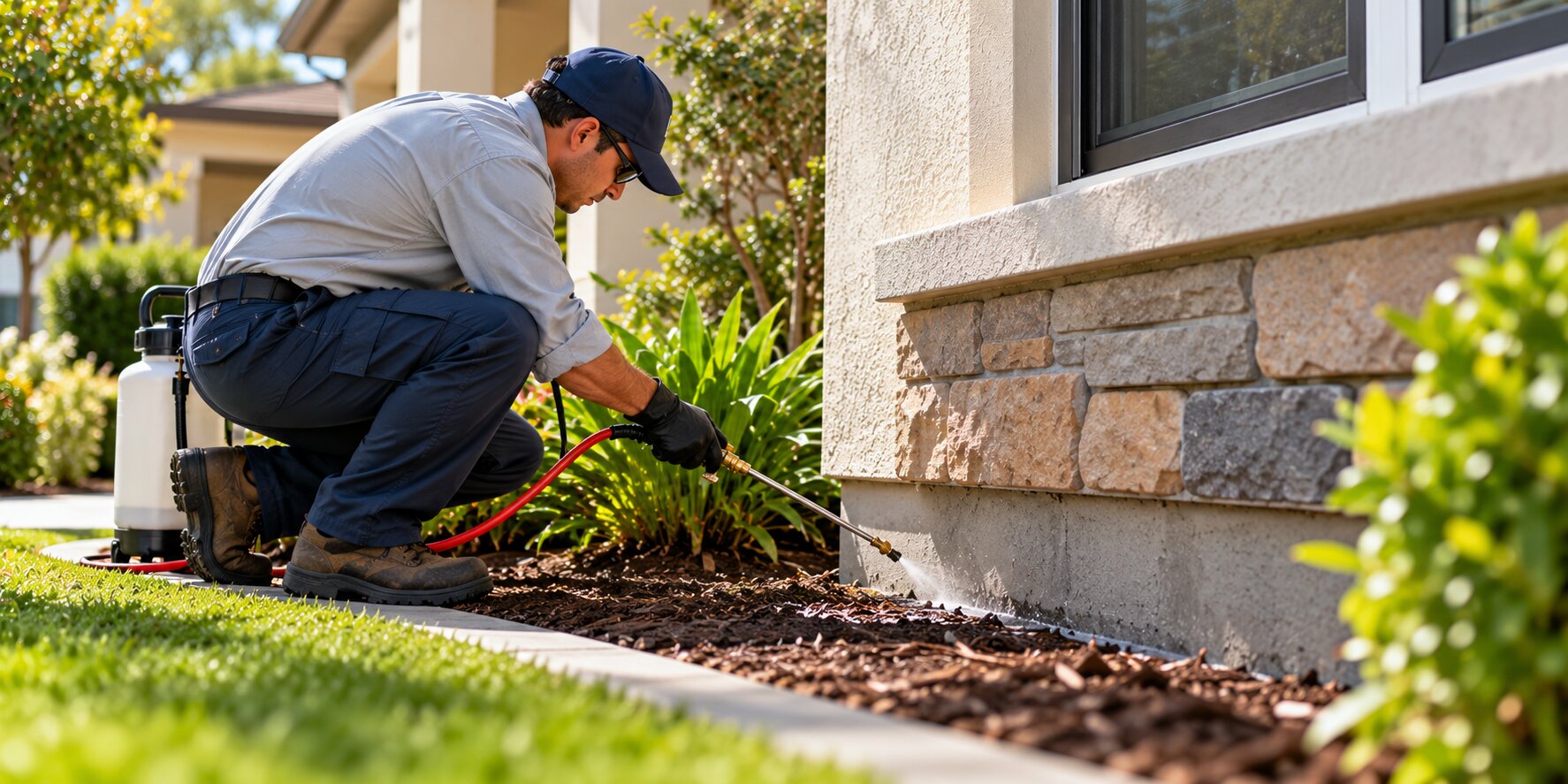

Discovering termites in your home raises an immediate question: what is the best way to get rid of them?
For Southern California homeowners, two common approaches for drywood termite problems are whole-structure fumigation and localized spot treatment. Both can play an important role in termite control, but they are designed for different situations.
Insight Pest Management helps homeowners throughout Ventura County understand which treatment approach makes sense based on the location, extent, and accessibility of the infestation. Led by Associate Certified Entomologist Israel Alvarez, Insight Pest Management uses detailed inspections and science-based recommendations instead of assuming every termite problem requires the same solution.
If you are trying to decide between fumigation and spot treatment, understanding how each method works can make the decision much clearer.
What Is the Difference Between Fumigation and Spot Treatment?
The biggest difference is the area being treated.
Spot treatment targets a specific location where termite activity has been identified.
Whole-structure fumigation treats the entire enclosed building.
That distinction matters because drywood termites live inside wood. If colonies are concentrated in one accessible area, localized treatment may be an option. If activity is widespread or hidden in multiple inaccessible locations, fumigation may provide more comprehensive coverage.
Neither method is automatically the right choice for every property.
The decision should begin with a professional inspection.
What Is Spot Treatment for Termites?
Spot treatment, sometimes called localized termite treatment, focuses directly on identified areas of termite activity.
Instead of treating the entire house, a pest professional addresses the affected wood or surrounding area.
Depending on the infestation and treatment method, this may involve accessing termite galleries and applying an appropriate treatment directly where activity has been found.
Localized treatments can be useful when inspectors can confidently identify where the infestation is located.
For example, imagine a Camarillo homeowner discovers drywood termite frass beneath one window frame. An inspection finds that the activity appears limited to that area, with no evidence detected elsewhere in the home.
In a situation like that, a localized treatment may be considered.
The key is determining whether the visible activity truly represents the full extent of the infestation.
What Is Whole-Structure Fumigation?
Whole-structure fumigation is a broader termite treatment.
During fumigation, the home is enclosed beneath specialized tarps and a gaseous fumigant is introduced into the structure.
Because the treatment is a gas, it can move through areas that may be difficult to reach directly, including:
- Wall cavities
- Attic framing
- Roof supports
- Ceiling joists
- Window and door framing
- Structural lumber
- Other enclosed wooden areas
After the required exposure period, the home is ventilated and professionally tested before occupants are allowed to return.
Fumigation can be especially valuable when drywood termite colonies are located in multiple parts of a house or in structural wood that cannot be effectively accessed for localized treatment.
When Might Spot Treatment Be Appropriate?
Spot treatment may be considered when termite activity appears limited and accessible.
Potential situations can include:
- A small infestation in one identified area
- Termite activity confined to a piece of accessible wood
- Limited evidence in a clearly defined location
- Situations where the entire affected area can be inspected and treated
The advantage is straightforward: only the affected portion of the property needs treatment.
This may mean less disruption to the household compared with whole-home fumigation.
However, localized treatment depends heavily on accurate detection.
If additional termite colonies are hidden elsewhere in the building, treating only the visible infestation may leave those colonies untouched.
That is one reason the quality of the initial inspection matters so much.
When Might Fumigation Be Recommended?
Whole-structure fumigation may be considered when drywood termite activity is more extensive.
Common situations can include:
- Evidence of termites in multiple rooms
- Termite colonies located in inaccessible framing
- Activity in both attic and living areas
- Repeated termite problems after localized treatment
- Signs suggesting multiple drywood termite colonies
- Widespread infestation throughout structural wood
Fumigation does not depend on locating and individually treating every termite gallery.
Instead, it provides treatment throughout the enclosed structure.
For widespread drywood termite infestations, that broader reach can be a major advantage.
How Do You Know How Widespread a Termite Infestation Is?
This is one of the hardest questions homeowners face.
Drywood termites spend much of their time completely hidden inside wood.
You may see only small clues.
Common signs include:
- Termite frass
- Discarded wings
- Swarmers
- Small openings in wood
- Hollow or damaged wood
- Repeated evidence in different areas
But seeing one pile of frass does not tell you exactly how many termites are present or how far the infestation extends.
A professional inspection helps put those signs into context.
The inspector looks beyond the obvious problem area and checks other portions of the structure for evidence of activity.
That additional investigation can make the difference between choosing an appropriately targeted treatment and missing hidden infestations.
What Are the Advantages of Spot Treatment?
Localized treatment can offer several advantages when it is appropriate for the infestation.
Less Household Disruption
Whole-home fumigation generally requires residents and pets to leave the property temporarily.
Localized treatment may involve significantly less interruption.
Focused Treatment
The treatment is applied directly to the area where termite activity has been identified.
No Whole-Structure Tenting
Because only the affected area is being treated, the entire home does not need to be enclosed beneath fumigation tarps.
Useful for Limited Infestations
If activity is genuinely confined to one accessible area, treating that specific location may be a practical option.
However, these benefits depend on the infestation being accurately located.
What Are the Limitations of Spot Treatment?
The main limitation is that termite colonies can be difficult to see.
Drywood termites can live inside wooden framing, beams, trim, and other components without producing obvious exterior evidence.
A localized treatment only addresses areas that are targeted.
If another colony exists in an untreated portion of the house, it may continue developing.
That does not mean spot treatment is ineffective. It means it is best suited to situations where the infestation can be confidently isolated.
A careful inspection helps determine whether that is realistic.
What Are the Advantages of Fumigation?
For widespread infestations, fumigation offers several important benefits.
It Treats the Entire Structure
Fumigation is not limited to the places where termite activity can be directly seen.
It Reaches Inaccessible Areas
Gas can move through structural spaces that may be difficult to reach with localized applications.
It Can Address Multiple Hidden Colonies
If drywood termites are active in several parts of a home, fumigation may address those areas during the same treatment.
It Reduces Dependence on Locating Every Gallery
Inspectors do not need to physically expose every individual termite gallery for the treatment to reach affected structural areas.
These characteristics are why fumigation is commonly discussed when infestations are widespread.
What Are the Limitations of Fumigation?
Fumigation also involves more preparation and disruption.
Homeowners typically need to leave the property during treatment and until the home has been cleared for re-entry.
Preparation may involve handling certain:
- Foods
- Medications
- Plants
- Pets
- Consumable products
- Exterior landscaping
The property also needs to be tented and later aerated.
For a limited infestation, that level of treatment may not always be necessary.
This is why the decision should be based on inspection findings rather than simply choosing the most extensive treatment available.
Does Fumigation Provide Permanent Termite Protection?
No termite treatment should be viewed as permanent protection against every future infestation.
Whole-structure fumigation is intended to address termites present within the treated structure at the time of treatment.
Drywood termite swarmers can potentially reach the property again in the future.
That makes ongoing prevention and inspection important even after successful treatment.
Homeowners can help by:
- Monitoring for termite frass
- Watching for swarmers
- Inspecting exposed wood
- Repairing damaged areas
- Keeping up with routine property maintenance
- Scheduling future termite inspections
Termite control works best as an ongoing process rather than a one-time reaction.
Is Spot Treatment Less Effective Than Fumigation?
Not necessarily.
The better question is whether the treatment matches the infestation.
If termites are located in one accessible section of wood and the infestation can be clearly identified, localized treatment may be appropriate.
If termites are spread throughout inaccessible portions of a home, treating one visible area is unlikely to address the entire problem.
Effectiveness therefore depends on factors such as:
- Pest identification
- Infestation size
- Number of affected areas
- Accessibility
- Inspection accuracy
- Treatment selection
- Professional application
This is why homeowners should be cautious about choosing a treatment method before having the property inspected.
How Does Insight Pest Management Decide Which Treatment to Recommend?
The process begins with understanding the infestation.
Insight Pest Management examines the property for termite evidence and considers where activity has been detected, how extensive it appears to be, and whether the affected areas can be accessed.
Led by Associate Certified Entomologist Israel Alvarez, the Insight team takes a science-based approach to these decisions.
Israel has nearly two decades of professional pest management experience and has held his Associate Certified Entomologist credential since 2013. His background helps the team evaluate how termites behave inside a structure rather than simply responding to the most visible evidence.
The goal is not to recommend the biggest treatment.
It is to recommend a treatment strategy that fits the actual conditions of the property.
Why Are Drywood Termites a Concern in Southern California?
Ventura County homeowners may encounter termite activity because Southern California provides conditions that can support termite populations.
Homes throughout Newbury Park, Thousand Oaks, Camarillo, Simi Valley, Moorpark, Oxnard, and surrounding communities contain wooden structural components that drywood termites may infest.
One challenge is that these termites can remain concealed.
A homeowner may notice a pile of tiny pellets near a baseboard and assume the problem is isolated. An inspection may confirm that assumption—or discover additional activity elsewhere.
That uncertainty is exactly why professional evaluation is so important.
What Questions Should You Ask Before Choosing a Treatment?
Homeowners should understand why a particular treatment is being recommended.
Useful questions include:
- What type of termite was identified?
- Where was active or suspected activity found?
- Is the infestation localized or widespread?
- Are affected areas accessible?
- Could additional colonies be hidden elsewhere?
- What are the advantages of localized treatment in this situation?
- Why might fumigation be recommended instead?
- What preparation is required?
- What should I expect after treatment?
- How can I monitor for future termite activity?
A knowledgeable pest professional should be willing to explain the reasoning behind the recommendation.
Homeowners should not feel like they have to choose between two treatments without understanding the evidence.
Can You Start With Spot Treatment and Fumigate Later?
In some circumstances, homeowners may choose localized treatment for an infestation that appears limited.
If additional termite activity appears later, further treatment may be necessary.
Whether that approach makes sense depends on the original inspection findings and the homeowner’s circumstances.
If there is already substantial evidence that termites are active throughout the structure, repeatedly treating individual areas may not address the broader infestation.
Conversely, fumigating an entire home for a clearly isolated problem may be unnecessary.
There is no universal answer.
The extent of the infestation should drive the treatment strategy.
Why Does Professional Experience Matter?
Termite treatment is not simply about finding insects.
It requires understanding how termites live, where colonies may develop, what evidence they leave behind, and which treatment methods can realistically reach them.
Insight Pest Management is founded and operated by Israel Alvarez, who brings nearly 20 years of professional pest management experience to the company.
Israel is an Associate Certified Entomologist and holds a California Pest Control Operators License. He also serves as Vice Chair of the Pest Control Operators of California–Ventura District.
That combination of field experience and entomological knowledge helps Insight Pest Management provide homeowners with recommendations grounded in pest biology and real property conditions.
Which Termite Treatment Is Right for Your Home?
The answer depends on what is happening inside your property.
Spot treatment may make sense when:
- The infestation is limited
- The affected area is accessible
- The termite activity can be confidently isolated
Fumigation may make more sense when:
- Activity appears throughout multiple areas
- Colonies may be hidden inside inaccessible wood
- The infestation is widespread
- Previous localized treatments have not addressed the broader problem
The most important thing is not choosing fumigation or spot treatment first.
It is getting an accurate inspection first.
Once you know where termites are active and how extensive the infestation appears to be, the appropriate treatment becomes much easier to determine.
Schedule a Termite Inspection With Insight Pest Management
If you’ve discovered termite frass, swarmers, damaged wood, or recurring activity around your property, you don’t have to decide between fumigation and spot treatment on your own.
Insight Pest Management provides detailed, science-based termite inspections for homeowners throughout Ventura County and nearby Southern California communities.
Schedule your inspection with Insight Pest Management today. The Insight team can evaluate the extent of your termite problem, explain the available treatment options, and help you develop a practical plan for protecting your home.