

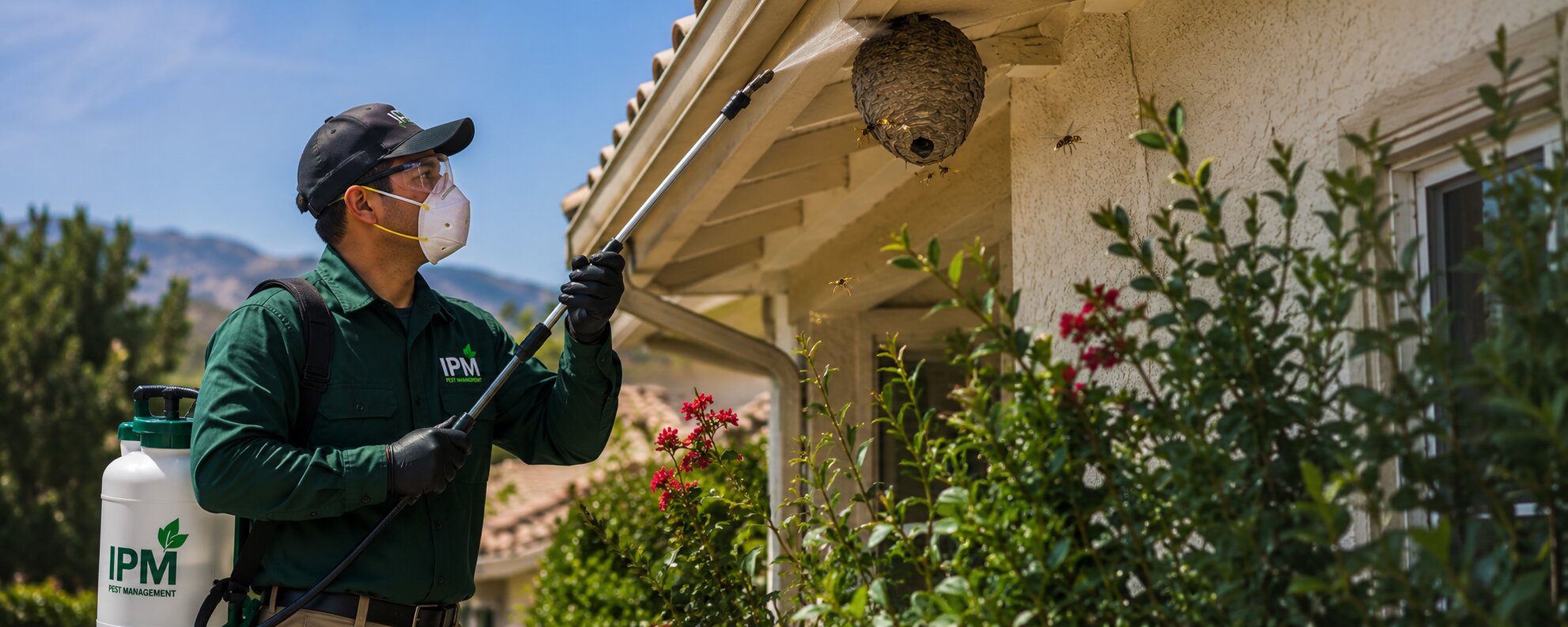

Wasp control in Simi Valley helps homeowners and businesses protect outdoor spaces from stinging insects that can make patios, entryways, gardens, and other frequently used areas uncomfortable or potentially dangerous. Insight Pest Management is proud to serve Simi Valley and surrounding Ventura County communities with effective, science-based wasp control solutions designed to address active nests, reduce unwanted activity, and help prevent recurring problems.
Imagine stepping outside to enjoy a warm afternoon on your patio, only to notice several wasps flying around the roofline. What initially seems like a minor inconvenience can become a serious concern when you discover a nest near a doorway, children’s play area, or frequently used outdoor space.
Wasps play an important role in the environment by controlling other insect populations, but their presence near homes and businesses can create safety concerns, particularly for individuals with allergies to insect stings.
Led by Associate Certified Entomologist Israel Alvarez, Insight Pest Management combines nearly 20 years of professional pest management experience with careful inspections and targeted control recommendations. Our team focuses on identifying the wasp species, locating nesting areas, and determining the most appropriate way to address the problem.
Contact Insight Pest Management today to schedule professional wasp control services in Simi Valley.
Why Are Wasps Common Around Simi Valley Homes?
Simi Valley’s warm Mediterranean climate, landscaped neighborhoods, and abundance of outdoor living spaces create conditions where wasps can find food, water, and suitable nesting locations.
Many wasp species become particularly noticeable during warmer months when colonies are actively growing and workers are searching for food.
Residential landscaping, outdoor dining areas, gardens, and building structures can provide attractive environments for these insects.
Common factors that attract wasps include:
- Accessible food sources: Outdoor meals, sugary drinks, fallen fruit, and uncovered garbage.
- Sheltered nesting locations: Roof eaves, patio covers, wall cavities, and outdoor structures.
- Water availability: Irrigation systems, birdbaths, and other moisture sources.
- Insect populations: Many wasps hunt insects to feed their developing young.
- Landscaping and vegetation: Trees, shrubs, and gardens provide hunting areas and potential nesting sites.
- Outdoor gatherings: Food and beverages left outside may attract foraging wasps.
A few wasps visiting flowers or hunting insects may be part of normal outdoor activity.
However, repeated wasp traffic around one location or a visible nest near an occupied area may require professional evaluation.
Understanding what attracts wasps is an important part of developing an effective control strategy.
What Types of Wasps Are Found in Simi Valley?
Southern California is home to several types of wasps and related stinging insects.
Correct identification helps determine their nesting habits, behavior, and the level of concern associated with their presence.
Paper Wasps
Paper wasps are commonly encountered around Southern California homes.
They typically have slender bodies, narrow waists, and long legs that hang beneath them during flight.
Paper wasps construct open, umbrella-shaped nests containing visible hexagonal cells.
These nests may be attached to:
- Roof eaves
- Patio covers
- Fence rails
- Outdoor light fixtures
- Sheds and garages
- Other protected structural surfaces
Paper wasps generally aren’t aggressive when away from their nests, but they may defend their colonies if disturbed.
Nests close to doors, walkways, and frequently used patios may create an increased risk of accidental contact.
Yellowjackets
Yellowjackets are social wasps recognizable by their compact bodies and contrasting yellow-and-black markings.
They may establish colonies in underground cavities, abandoned rodent burrows, wall voids, or other protected spaces.
Yellowjackets can be particularly troublesome around outdoor dining areas because some species are attracted to sugary foods, meats, and other human food sources.
They may aggressively defend their nests when disturbed.
Because underground nests can be difficult to notice, homeowners sometimes encounter yellowjackets unexpectedly while gardening or performing yard maintenance.
Mud Dauber Wasps
Mud daubers are solitary wasps that construct distinctive nests from mud.
These nests may appear as small tubes or clusters attached to walls, garages, patios, and sheltered structures.
Mud daubers typically hunt spiders to provide food for their developing young.
They are generally less defensive than social wasps because they don’t maintain large colonies of workers.
Although their nests may be inconvenient or unattractive, they usually present a lower sting risk than an active yellowjacket colony.
Other Solitary Wasps
Simi Valley properties may also attract solitary wasps that hunt insects or spiders.
Some nest in soil, while others use small cavities or sheltered spaces.
These wasps can provide ecological benefits and don’t necessarily require treatment unless their activity creates a specific safety concern.
Identifying the species before treatment helps avoid unnecessary control measures and ensures that more concerning infestations receive appropriate attention.
How Can You Tell If You Have a Wasp Nest?
Wasps may visit a property temporarily while searching for food, so occasional sightings don’t always indicate an established nest.
However, certain patterns suggest that a colony may be located nearby.
Common warning signs include:
- Multiple wasps repeatedly entering and leaving the same opening
- An exposed paper nest beneath a roof eave or patio cover
- Concentrated activity around a ground opening
- Wasps emerging from cracks in siding or exterior walls
- Increased wasp activity near outdoor trash containers
- Defensive behavior when people approach a specific area
For example, a Simi Valley homeowner might notice wasps frequently flying beneath a patio roof.
After observing the area from a safe distance, they may discover a paper nest attached to an overhead beam.
Alternatively, repeated yellowjacket activity near a landscaping bed could indicate an underground nest that isn’t immediately visible.
Homeowners should avoid disturbing suspected nests or attempting to block active entrances.
A professional inspection can help identify the nesting location and determine whether removal or treatment is necessary.
Why Is Professional Wasp Control Important?
Attempting to remove a wasp nest without proper training can expose homeowners to multiple stings.
Social wasps may respond defensively when their nests are disturbed, particularly when colonies are well established.
Some species can sting repeatedly, increasing the risk of injury during an unsuccessful removal attempt.
Professional wasp control is especially important when:
- A nest is located near a main entrance
- Yellowjackets are nesting in the ground
- Wasps are entering a wall or roof cavity
- A nest is positioned high above the ground
- Children or pets regularly use the affected area
- Someone on the property has a history of severe reactions to stings
- Wasps are behaving defensively around frequently used spaces
Certain situations may also require special access equipment or treatment methods.
An experienced pest management professional can evaluate the circumstances and recommend an approach that reduces unnecessary exposure.
How Does Insight Pest Management Provide Wasp Control?
Insight Pest Management uses a science-based process to evaluate wasp activity and recommend targeted management solutions.
Our approach considers the species, nesting location, colony behavior, and surrounding property conditions.
Step 1: Inspect and Identify Wasp Activity
Our team begins by evaluating the areas where wasps have been observed.
Depending on the property, an inspection may include:
- Roof eaves and overhangs
- Patios and outdoor structures
- Garages and sheds
- Exterior walls and utility openings
- Landscaping beds and ground cavities
- Fences and outdoor storage areas
- Areas surrounding trash containers and outdoor dining spaces
We look for visible nests, repeated flight patterns, and potential nesting locations.
Identifying the wasp species helps determine the most appropriate response.
Step 2: Evaluate Nest Location and Safety Risks
Not all wasp activity requires the same level of intervention.
An isolated solitary wasp nest away from occupied areas may present relatively little risk.
By comparison, an active yellowjacket colony next to a frequently used walkway may require prompt professional attention.
Our team evaluates the nest’s location, accessibility, surrounding activity, and likelihood of accidental disturbance.
Step 3: Recommend Targeted Wasp Treatment or Removal
Treatment recommendations depend on the wasp species, nest size, location, and environmental conditions.
Appropriate management may involve:
- Targeted treatment of active social wasp nests
- Physical nest removal when suitable and safe
- Management of nesting activity around structural openings
- Recommendations for reducing food and water attractants
- Monitoring areas where wasps have repeatedly established nests
Pest control products, when necessary, should be selected and applied according to their labeling and applicable regulations.
For nests inside structural cavities, treatment planning requires additional care to avoid unnecessarily disturbing the colony or creating access to occupied spaces.
Step 4: Address Conditions That Attract Wasps
Managing an existing nest is only one part of effective wasp control.
Our team also looks for conditions that encourage wasps to return, including accessible food sources, open trash containers, and favorable nesting locations.
We provide practical recommendations for reducing these attractants.
Step 5: Discuss Prevention and Ongoing Monitoring
Wasp activity can vary throughout the year.
Properties that repeatedly develop nests may benefit from seasonal monitoring and preventive maintenance.
Follow-up recommendations depend on the species, infestation severity, and conditions identified during the inspection.
Schedule a wasp inspection with Insight Pest Management to identify nesting activity and explore appropriate control options for your Simi Valley property.
Why Choose Insight Pest Management for Wasp Control in Simi Valley?
Effective wasp management requires more than locating a nest.
Understanding wasp behavior, identifying the species, and evaluating potential safety concerns are essential parts of choosing the right approach.
Insight Pest Management combines professional expertise with local experience and personalized customer care.
Led by an Experienced Entomologist
Owner and operator Israel Alvarez brings nearly two decades of hands-on pest management experience to the company.
Israel has held the Associate Certified Entomologist credential since 2013 and earned his California Pest Control Operators License in 2014.
He also serves as Vice Chair of the Pest Control Operators of California’s Ventura District and completed the National Pest Management Association’s Executive Leadership Program in 2019.
His professional background supports the company’s commitment to accurate pest identification, responsible treatment practices, and science-based management.
Local Knowledge of Southern California
Wasp activity in Ventura County is influenced by warm weather, landscaping, seasonal insect populations, and available nesting locations.
Our familiarity with Simi Valley and surrounding communities helps us recognize conditions that contribute to recurring wasp activity.
Targeted, Prevention-First Solutions
We believe pest management should be based on the specific problem rather than unnecessary widespread applications.
Our team focuses on identifying active nesting areas and recommending appropriate control measures that address the source of the concern.
Clear Communication and Customer Education
Discovering a wasp nest near your home can be stressful.
Our team explains what was found, whether the activity presents a significant concern, and which treatment or prevention options may be appropriate.
How Can Simi Valley Homeowners Prevent Wasp Problems?
Although no property can be made completely unattractive to wasps, several practical habits can reduce conditions that encourage nesting and repeated activity.
Consider these preventive measures:
- Keep outdoor food covered: Avoid leaving meals, sugary beverages, and food scraps exposed.
- Secure trash containers: Use tightly fitting lids and clean spills around garbage areas.
- Remove fallen fruit: Pick up fruit that drops from trees before it begins attracting insects.
- Maintain exterior structures: Repair damaged screens and seal suitable gaps when they aren’t being used by active nests.
- Monitor sheltered areas: Visually check eaves, patio covers, and sheds for developing nests from a safe distance.
- Manage outdoor water sources: Correct unnecessary leaks and standing water.
- Use caution around landscaping: Watch for concentrated wasp activity before trimming shrubs or working near ground openings.
- Avoid disturbing nests: Don’t strike, spray, burn, or attempt to knock down an active nest without appropriate training.
Homeowners should also avoid sealing an entrance while wasps are actively using a wall cavity. Trapped insects may seek alternative routes, potentially moving into occupied areas.
If you suspect an established colony, professional evaluation is generally the safer option.
When Is Wasp Activity Most Common in Simi Valley?
Simi Valley’s mild climate can support wasp activity across much of the year, although activity often becomes more noticeable during warmer months.
In spring, reproductive females of many social wasp species begin establishing new colonies.
As temperatures rise, developing colonies may produce increasing numbers of workers.
During summer, wasps frequently forage around gardens, landscaping, and outdoor food sources.
By late summer and fall, some colonies become larger and more noticeable around residential properties.
Seasonal patterns vary by species and weather conditions, but homeowners should remain aware of nesting activity during periods when outdoor spaces are frequently used.
Early identification of nests in high-traffic areas can help reduce the chance of accidental disturbance.
Frequently Asked Questions About Wasp Control in Simi Valley
Are wasps dangerous?
Most wasps don’t actively seek out people to sting, but some species will defend their nests when disturbed.
Stings can cause pain, swelling, and allergic reactions. People with severe allergies may experience life-threatening anaphylaxis.
If someone develops difficulty breathing, throat swelling, faintness, or other symptoms of a severe allergic reaction after a sting, call 911 immediately.
What’s the difference between wasps and bees?
Many wasps have smooth, relatively slender bodies, while honey bees are generally hairier and collect pollen.
However, appearances and behaviors vary by species.
Correct identification matters because bees and wasps may require different management approaches.
Should I remove a wasp nest myself?
Removing an active nest can be dangerous, particularly if the colony is large, difficult to reach, or located inside a structure.
Professional assistance is recommended when a nest creates a risk of multiple stings or is near frequently occupied areas.
Will wasps return after a nest is removed?
New wasps may establish nests in the same general area if favorable conditions remain.
Removing an active nest doesn’t permanently prevent future colonies from selecting nearby protected locations.
Do wasps nest inside walls?
Yes. Certain social wasps, including yellowjackets, may establish nests in wall voids and other structural cavities.
Repeated wasp activity around an exterior opening may indicate a concealed nest.
Avoid sealing that opening until the situation has been professionally evaluated.
Can wasp control be performed around pets and children?
Professional treatments should account for children, pets, and other occupants.
Specific precautions depend on the products, application methods, and treatment locations.
Follow all preparation and reentry instructions provided by the pest management professional.
Are all wasps harmful to have around?
No. Many wasps are beneficial predators that help control other insects, and some contribute to pollination.
Control is generally most important when nesting activity creates a safety concern or interferes with normal property use.
Schedule Professional Wasp Control in Simi Valley Today
An active wasp nest near your home or business can quickly interfere with outdoor activities and create unnecessary risks for family members, employees, customers, and visitors.
Insight Pest Management provides professional wasp control solutions focused on accurate identification, targeted nest management, and practical prevention.
Led by Associate Certified Entomologist Israel Alvarez, our locally owned company proudly serves Simi Valley, Moorpark, Thousand Oaks, Newbury Park, Camarillo, and surrounding Ventura County communities.
Whether you’ve discovered a paper wasp nest beneath your patio, noticed yellowjackets emerging from the ground, or are concerned about persistent stinging insect activity, our knowledgeable team can help you evaluate the situation.
Call Insight Pest Management today to schedule your wasp control inspection and enjoy greater peace of mind around your Simi Valley property.