

'/%3E%3Cpath%20fill='%23b2b2b2'%20d='M241%20382q0%2016%2017%2026%2017%2011%2042%2011t42-11q16-11%2017-26V269H241'/%3E%3Cpath%20fill='%239f7e00'%20d='M241%20379q0%2014%208%2023%209%209%2021%209%2014%200%2021-9%209-9%209-23V269h-59'/%3E%3Cpath%20d='M241%20339v-70h59v110q0%2014-9%2023l-6%205v-68h-15v72q-8%200-14-4v-68zm59%2040c0%2022%2015%2032%2029%2032%2021%200%2030-18%2030-32v-40h-59'/%3E%3Cpath%20fill='%239f7e00'%20d='M266%20277v5h2v12h-3v-5h2v-5h-9v5h2v5h-4v9h3v18h-5v10h34v-10h-5v-18h3v-9h-4v-5h2v-5h-9v5h2v5h-3v-12h2v-5zm42%20101q0%2010%206%2017%206%206%2015%207%2010-1%2016-7%206-7%206-17v-29h-43'/%3E%3Ccircle%20fill='%230044ad'%20cx='329.5'%20cy='372'%20r='6'/%3E%3Cellipse%20fill='%230044ad'%20cx='300'%20cy='340'%20rx='16'%20ry='21'/%3E%3C/svg%3E)

Imagine pulling back a piece of baseboard trim and finding hollow, papery wood laced with tiny tunnels and realizing you have no idea how long the damage has been there. It’s a scenario that plays out regularly in homes across Ventura County, and it almost always leads to the same question: do we need to tent the house?
Tenting, or structural fumigation, is one of the most effective termite treatments available. But it’s also one of the most disruptive, and it’s not always the right call. At Insight Pest Management, owner and Associate Certified Entomologist Israel Alvarez helps Ventura County homeowners work through this exact decision every week, backed by nearly 20 years of hands-on experience treating termite infestations throughout Southern California.
Here’s what you need to understand before making the call.
What Is Tenting?
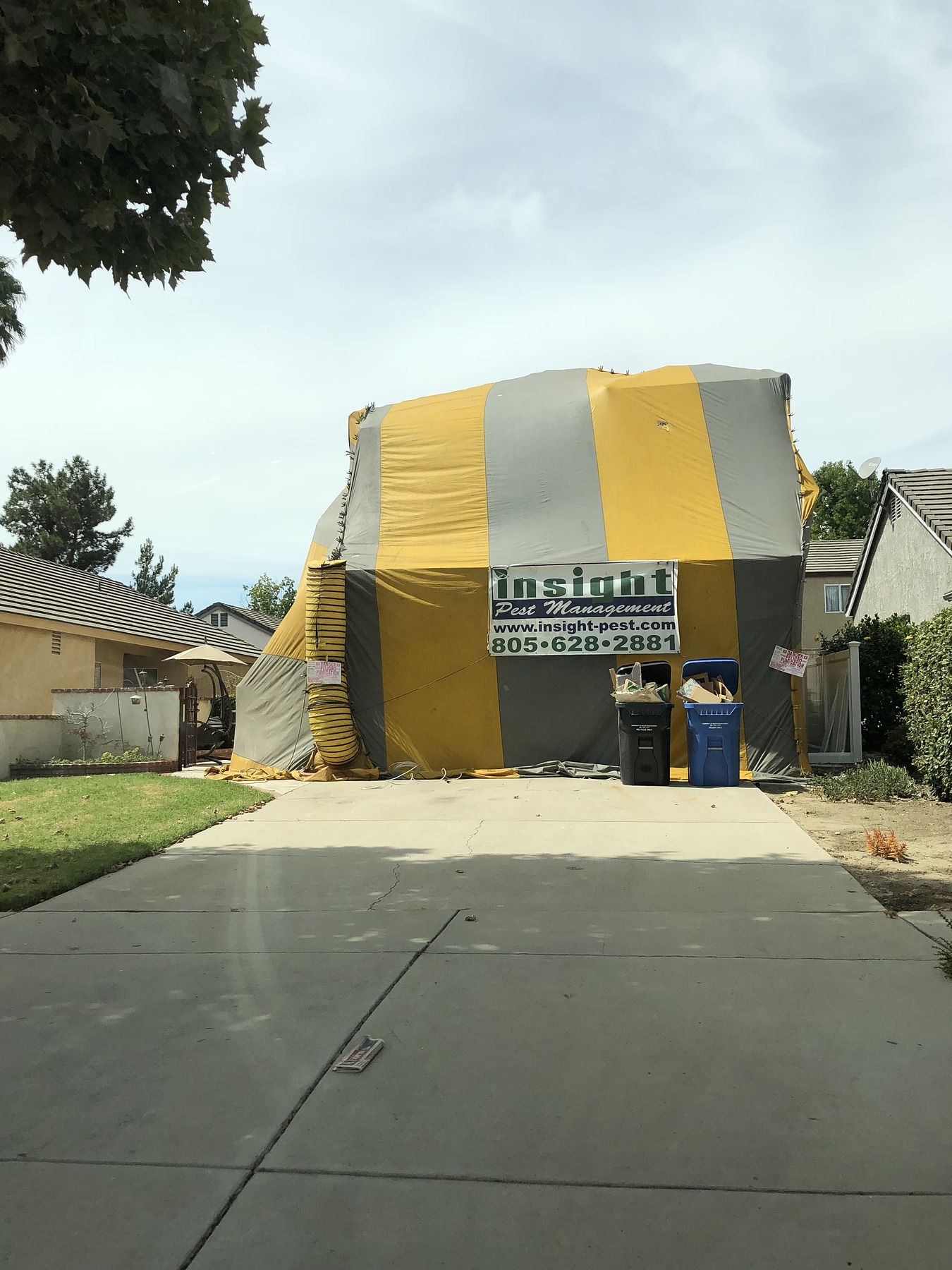
Tenting, formally called structural fumigation, involves sealing your entire home beneath a large tent and filling the enclosed space with a gas, typically sulfuryl fluoride. The gas penetrates wood, wall voids, attic spaces, and other hard-to-reach areas where drywood termites nest and feed. After a set exposure period, the tent comes down, the gas dissipates, and the home is cleared for re-entry, usually within 24 to 72 hours.
It’s a whole-structure solution. When drywood termites have spread throughout multiple areas of a home, fumigation reaches places that spot treatments simply can’t. That’s its biggest advantage.
When Tenting Is the Right Choice
Not every termite problem requires fumigation, but some situations make it the clear best option. Israel Alvarez recommends tenting when:
- The infestation is widespread — multiple rooms, multiple stories, or multiple wood members are affected.
- Drywood termites have established colonies in inaccessible areas, such as inside walls, in roof rafters, or deep within structural beams.
- Previous spot treatments haven’t fully resolved the problem and termites continue to swarm or show active activity.
- A thorough inspection reveals evidence of significant structural damage that points to a long-standing, established infestation.
Southern California’s dry, warm climate is ideal for drywood termites — they don’t need soil contact or moisture to survive, which means they can quietly colonize the wood framing of a home for years before homeowners notice any visible signs. By the time damage is apparent, the colony may have spread well beyond what the eye can see.
When Spot Treatments Are Enough
Tenting isn’t always necessary, and Insight Pest Management prides itself on recommending the right treatment — not the most expensive one. Spot treatments are a strong option when:
- The infestation is localized — confined to one area, such as a window frame, a door jamb, or a single piece of structural wood.
- The colony is accessible enough to treat directly with targeted methods like foam, dust, or microwave heat treatment.
- An early inspection catches the problem before it spreads, giving spot treatment a real chance to eliminate the colony at the source.
The key is catching it early. When one Newbury Park homeowner noticed a small pile of termite frass — the gritty, pellet-like droppings drywood termites push out of their galleries — near a window sill, Insight Pest Management performed a full inspection and identified a single, contained colony. A targeted spot treatment resolved it without any need for fumigation. That’s the ideal outcome: early detection, minimal intervention, lasting results.
Schedule your inspection with certified entomologist Israel Alvarez and the Insight team — and catch problems early, before they grow.
What to Expect During the Fumigation Process
If tenting is the recommended path, Insight Pest Management walks homeowners through every step. The process typically includes:
- Pre-fumigation preparation — bagging or removing food, medications, and plants; making arrangements for pets and houseplants.
- Tent installation — the structure is sealed completely, and neighboring properties are notified.
- Gas introduction and exposure period — the fumigant is released and allowed to penetrate all wood members over a period of 24 to 72 hours.
- Aeration — the tent is removed and the structure is ventilated thoroughly until gas levels drop to safe, undetectable levels.
- Clearance — a certified technician tests the air inside the home before anyone re-enters.
The disruption is real — you’ll need to be out of your home for two to three nights. But when the situation calls for it, fumigation is the most thorough and reliable way to eliminate an entrenched drywood termite infestation. Think of it as a reset: when it’s done correctly, you’re starting fresh.
What Fumigation Doesn’t Do
This is a point Israel Alvarez makes consistently with homeowners: fumigation eliminates the current infestation, but it provides no residual protection. Once the gas dissipates, it’s gone. There’s nothing left in the wood to prevent new termites from entering your home in the future.
That’s why a post-fumigation prevention plan matters. Insight Pest Management recommends pairing any major termite treatment with an ongoing inspection schedule and, where appropriate, preventive wood treatments or barrier applications to reduce the risk of re-infestation. Southern California homes don’t get a permanent pass after fumigation — the climate and environment that made your home attractive to termites in the first place haven’t changed.
How Insight Pest Management Approaches the Decision
There’s no single right answer for every home, and that’s exactly why the inspection process matters so much. Led by Associate Certified Entomologist Israel Alvarez — who holds a California Pest Control Operators License and serves as Vice Chair of the Pest Control Operators of California, Ventura District — Insight Pest Management takes a thorough, science-based approach to every evaluation.
That means inspecting accessible and inaccessible wood members, looking for frass, swarmers, and evidence of active feeding, and giving homeowners an honest picture of what they’re dealing with. The goal isn’t to recommend the most intensive treatment available. It’s to recommend the right one — and to make sure you understand why.
Tenting is sometimes the right answer. Spot treatment is sometimes the right answer. And sometimes the answer is a combination of both, paired with a long-term monitoring plan. What matters is that the decision is grounded in evidence, not guesswork.
Protect your home with Insight’s proven, science-backed pest control plans. Call Insight Pest Management in Ventura County today.
Don’t Wait on a Termite Problem
Termites don’t take breaks, and infestations don’t get smaller on their own. Whether you’ve spotted swarmers in the spring, noticed unexplained frass near a door frame, or just bought a home and want peace of mind, a professional inspection is the logical first step.
Founded and operated by Israel Alvarez, Insight Pest Management has become a trusted name in Southern California pest control — not because we always recommend the most aggressive treatment, but because we take the time to get it right. Call today to schedule your inspection and experience the Insight difference: professional, knowledgeable, and always on your side.
Call Insight Pest Management today to schedule your termite inspection and find out whether tenting is the right choice for your home.